On this page: Opportunity | Solution | Impact
The Opportunity
Paving the way to net zero in an emission-heavy industry
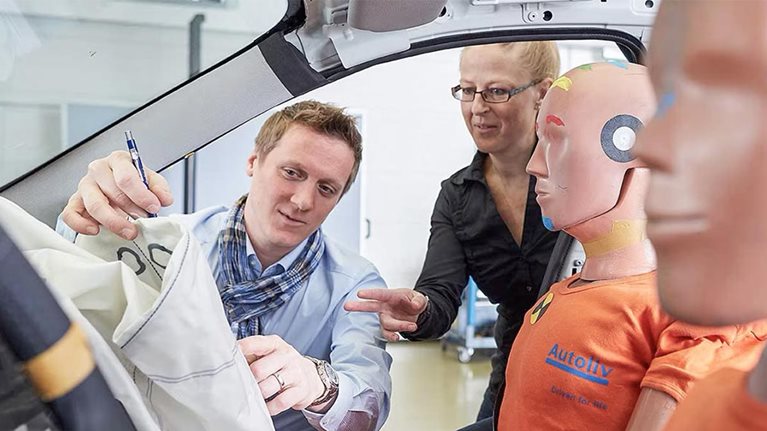
Autoliv builds the seatbelts, airbags, and other equipment that keep us safe behind the wheel. Based in Stockholm, the company holds more than 40 percent of the global market share for automobile safety equipment.
It also plays a crucial role in the auto industry's carbon reduction efforts. With more than 69,000 employees worldwide, operations in 27 countries, and emission data spanning 170 sites and 10 workstreams, the company’s decarbonization strategy is as complex as it is important.
Over the years, Autoliv has worked with Material Economics, a sustainability consultancy acquired by McKinsey in 2021, to design a climate strategy and set climate targets. Autoliv set the ambitious goal of becoming carbon neutral across its own operations by 2030 and net zero across its value chain by 2040.

To get there, the company worked closely with Material Economics on building a foundational climate program. This included fifteen sustainability projects, targets and KPIs across business units and product lines tracked for quarterly progress by a CEO-led sustainability board.
“The problem most companies face today is they are using very generic emission factors based on global averages that are not specific to what’s actually going on in their business,” says McKinsey partner Anders Suneson. “If you’re in the industry leading this transition, that quickly becomes an obsolete solution. To make an impact, you have to be much more precise in the factors you apply to your activity data.”
In 2023, ready to scale its climate program across all operations, Autoliv knew it needed to first get clear on its existing emissions data. This required figuring out how to connect emissions numbers across geographies for all specific materials that went into each product, such as a seatbelt. The company partnered with McKinsey’s Material Economics, Catalyst Zero, and QuantumBlack teams to do so.
“We were ready to take on decarbonization holistically across our value chain,” says Autoliv executive vice president of global supply chain management Christian Swahn. “The enormous complexity of this challenge meant we would need full transparency of our emission data.”
The Solution
A data transformation journey
To establish this transparency, Autoliv worked with QuantumBlack, AI by McKinsey to consolidate company-wide emission data across its supply chain, and use machine learning to map and ingest that data into McKinsey’s proprietary decarbonization asset, Catalyst Zero. This allows Autoliv to see just how emission-intensive materials are, creating a carbon footprint for every product line across its 170 sites and 10 workstreams.
“Sustainability touches everything. That’s why you need to collect data,” says McKinsey Catalyst Zero senior asset leader Tim Vroman. “By embarking on a journey towards net zero, you will also embark on a data transformation.”
Autoliv can now track carbon emissions across the company, down to the granular level of materials that go into each product. For a seat belt, for example, the company can now track emissions data from the metal in the buckle or the polyester for the strap.
After establishing full emission transparency across the supply chain, the next step was taking concrete actions to reduce those emissions. This required building detailed business cases across regions, materials, and technologies for steps that could be taken to reduce carbon emissions.
We were ready to take on decarbonization holistically across our value chain... The enormous complexity of this challenge meant we would need full transparency of our emission data.
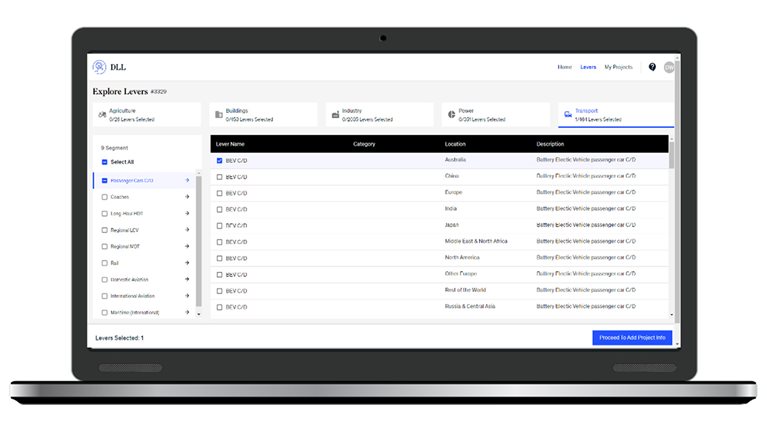
To do this, Autoliv worked with McKinsey to check its data against our proprietary decarbonization library, which includes more than 1,200 decarbonization levers across a wide range of materials, sectors, and regions. Adding this layer of data to the equation gave Autoliv visibility into business cases across sectors, regions, and production routes.
“Access to McKinsey’s decarbonization library answers the question: What is clean tech going to cost me today? In five years’ time? In 10 years’ time?” says Tim. “The view is not static. It’s available up to 2050 to ensure companies can make the right tradeoffs in sequencing. Do they want to implement something now? Is it a 2030 initiative? That sequencing becomes possible with that full fact base in hand.”
All of this data was made easily searchable and useable via Catalyst Zero. Establishing this single source of truth across the organization gives Autoliv the ability to analyze emissions data from a company-wide lens down to a component-specific level, ensuring everyone at the organization is working with the same numbers.
“This process has helped set up a future-proof greenhouse gas accounting solution across the organization,” says McKinsey partner, Robert Westerdahl. “Now they can approach future products and suppliers armed with the data they need to make the best business decisions prioritizing sustainability.”
With the platform and tools in place, the next step in the process was empowering employees through capability building. Across the company, 350 employees have been trained to use the platform, with an eye toward training people who would then go on to train others across the company.

The Impact
A baseline, a pathway, and a plan of action
To date, Autoliv is tracking more than 500 climate projects. So far, these efforts have identified paths to reducing scope 1 and 2 annual carbon emissions by 215 kilotons a year, which amounts to nearly half of all direct emissions owned and controlled by Autoliv for 2022.
This work is helping Autoliv get closer to its goal of becoming carbon neutral across its own operations by 2030 and reaching net-zero emissions across the value chain by 2040.
Thanks to the company’s end-to-end GHG accounting solution, Autoliv leaders can view climate program and greenhouse gas data across all business operations, divisions, and product lines. Information from Autoliv’s internal accounting system has been successfully paired with this to identify the carbon cost of each material or step.
“We are leaving behind a productionized solution. This is now an operational system on their end,” says Anders. “This was not a blueprint of what they should do. It was actually building the thing they want to have.”
This has given Autoliv the ability to reduce and measure the impact of emissions through increased productivity, low-carbon supplies, and reduced energy consumption. It has helped improve operational efficiency, allowing the company to respond to supplier and customer requests more quickly. And it has also created a company-wide source of truth when it comes to emission transparency. In addition to providing reliable and consistent data for emissions reporting requirements, this also allows Autoliv to better negotiate with suppliers on pricing.
“We are continuously working to reinforce responsible business requirements into our sourcing decisions,” says Autoliv vice president of sustainability Kaisa Tarna-Mani. “We really want to integrate sustainability into everything that we do.”
Our people
Robert Westerdahl
Related
How a global components manufacturer built an ambitious carbon reduction roadmap

Building a next-generation carbon platform to accelerate the path to net zero